
Financial Aid 101

It’s never too early to start learning about financial planning, whether you’re trying to figure out financial aid for college or want to learn to save money from an after-school job. Money is necessary, and as hard as you work to get it, it’s equally important to learn how to make that money work for you.
If you’re planning to attend college or a career technology center, you’re going to need money. Fortunately, there are lots of ways to plan and pay for these expenses.
Financial aid is available to all eligible students to assist with the cost of their higher education. Aid is provided federally and through your state of residence. It comes in the form of grants, work programs, student loans, and scholarships. The first step in applying for aid is to complete the FAFSA, Free Application for Federal Student Aid.
 The FAFSA will ask about your family’s financial situation and take a snap-shot of your and your parents’ income, assets and investments to determine the types of aid you’re eligible to receive.
After your FAFSA has been processed, the results will be sent to the schools you listed on the application. Those schools will determine your eligibility for financial aid and send you a financial aid offer. The aid offer will list the types of aid you may receive to attend their school. You should always accept free money first on your offer. Free money is not required to be paid back upon graduation. Grants and scholarships are typically considered free money. Here are some examples.
Types of Federal and State Grants
- Pell Grant — Available to undergraduate students with exceptional financial need who have not yet earned a bachelor's degree. The maximum Pell Grant award is currently $7,395, depending on the student's eligibility.
- Federal Supplemental Educational Opportunity Grant (FSEOG) — A grant for undergraduate students who demonstrate exceptional financial need to help pay for their education. Awards can range from $100-$4,000, depending on the student's eligibility and the availability of funds at the school.
- Teacher Education Assistance for College and Higher Education (TEACH) Grant — A federal program that provides grants to students who are studying to become teachers. This program is designed to encourage individuals to teach in high-need fields and low-income schools after graduation. If this requirement is not fulfilled, the grant becomes a loan and must be repaid by the student.
- Oklahoma Tuition Aid Grant Program (OTAG) — A need-based grant program for Oklahoma residents who attend eligible colleges, universities and career technology centers in Oklahoma.
- Oklahoma Tuition Equalization Grant Program (OTEG) — A need-based grant program for Oklahoma residents who attend certain qualified Oklahoma not-for-profit, private/independent institutions of higher education.
Federal Work-Study — A type of federal financial aid that provides part-time jobs for students with financial need, allowing them to earn money to help pay for their education expenses. Work-study is a great way to build work experience!
After you’ve utilized your grants, scholarships and personal savings to finance your college education, you may find yourself in need of extra funds to manage your school expenses. In such instances, federal student loans are an option to consider. It is important to recognize that a student loan represents a significant commitment. Repayment is required regardless of whether you complete your degree or decide to withdraw prior to graduation. Failure to repay your loan could adversely affect your credit score and may result in wage garnishment.
Types of Federal Loans
- Direct subsidized loans — A type of federal student loan funded by the federal government to undergraduate students with demonstrated financial need. The key benefit is that the government pays the interest on the loan while the borrower is in school at least half-time, during grace periods and during periods of deferment. This can significantly reduce the total cost of the loan over time compared to unsubsidized loans.
- Direct unsubsidized loans — A type of federal student loan available to both undergraduate and graduate students, regardless of financial need. Unlike subsidized loans, the government does not pay the interest while you're in school, during deferment or during the grace period. The student is responsible for the interest that accrues from the moment the loan is disbursed until it's paid in full.
- Direct PLUS loans — A federal student loan offered to parents* of dependent undergraduate students, or to graduate and professional students** to help cover the cost of higher education. It allows borrowers to assist in covering the cost of attendance and is distinct from other federal student loans because it's in the parent's name (for Parent PLUS loans) or the student's name (for Grad PLUS loans). Unlike other federal student loans, PLUS Loans require a credit check.
Important to Note:
*Parents who take out a PLUS loan for their students’ education cannot transfer this loan to their student once they leave school.
More specific information can be found at the Federal Student Aid website.
Private vs Federal Loans
A private student loan is a non-federal loan, offered by private lenders like banks, credit unions, or other financial institutions, to help students cover the cost of education. Unlike federal student loans, private loans are not backed by the government and typically require a credit check and sometimes a cosigner. Do your homework before deciding on private vs. federal loans. Many private loans are becoming much more competitive.
Ready Set Repay
To learn more about successfully managing and repaying student loans, visit ReadySetRepay.org.

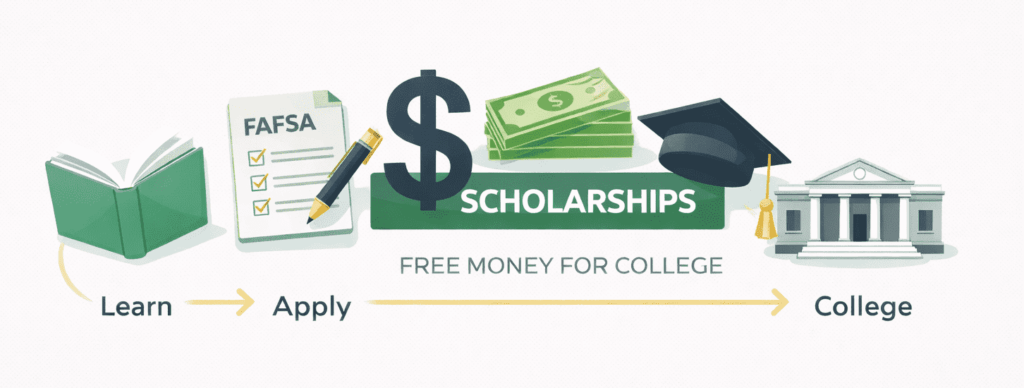 Another great source of financial aid is scholarships! A scholarship is a form of aid awarded to students to help them pay for their education. Unlike loans, scholarships don't need to be repaid. They are typically awarded based on a variety of criteria, including academic merit, financial need, athletic skill, or artistic talent. There are millions of dollars of scholarships awarded annually.
Scholarships come in various forms, with differing amounts, and can be awarded for a single academic year or for multiple years. Regardless of their type, scholarships serve as an excellent source of free financial aid to help cover your educational expenses.
Applying for Scholarships
The key aspect of applying for scholarships is understanding how to locate them. Fortunately, numerous resources are accessible to students. Try these options:
- Consult your high school counselor or the financial aid office at the college or university you wish to attend.
- Access your preferred search engine and enter "Scholarship for X," where X represents an area of interest, whether academic or personal.
- Read through scholarship books at the library for lists of scholarships by topic and by state.
- Find awards for things such as sports, media, disabilities, ethnicity, grades, test scores or brands.
Review our Scholarship Success Guide with links to scholarship search engines as well as Native American entities in Oklahoma. Additionally, there are local scholarship databases that you can utilize such as OKcollegestart and UCanGo2. Students can start applying for scholarships in middle school and should continue all through college.
Scholarship Requirements and Deadlines
It is extremely important to pay close attention to scholarship deadlines, as missing them, even by a short time, can result in disqualification. Some scholarships may offer flexibility, but generally, deadlines are firm. To manage these deadlines effectively, it's recommended to create a calendar or spreadsheet to track application due dates and requirements, set reminders well in advance, and prioritize scholarships based on urgency and relevance to your goals. Additionally, consider requesting letters of recommendation from teachers or mentors well before the due date, as this part of the process can take time. Staying organized and proactive significantly increases your chances of securing valuable financial aid for your education.
Scholarship Tips
Here are several final considerations to keep in mind concerning scholarships.
- Steer clear of websites that require payment. There should never be a charge to apply for a scholarship. The purpose is to secure funds for you, not to extract money from you.
- The more localized the scholarship, the less competition you’ll face, so seek out local organizations, religious institutions and employers that provide scholarships.
- Don’t shy away from essays. Scholarships that require an essay will attract fewer applicants, resulting in reduced competition for you.
- Always meet your deadlines!
It is often easier said than done, yet if feasible, allocating some funds into a savings account can yield significant returns when the time arrives for college. For students in Oklahoma, the Oklahoma 529 plan presents an excellent opportunity. It offers a flexible and tax-advantaged method for saving for higher education. The 529 plan stands out as the optimal choice for Oklahoma students to accumulate savings for their academic pursuits. For further information on the unique tax benefits, please explore the Oklahoma 529 college savings plan.